
UNDERSTANDING VESSEL STANDARDS
Know the standardsbehind your boat.
The New Zealand Builders Plate is a formal declaration that a boat conforms to a recognised standard, backed by evidence. It can be applied to new, newly imported and existing vessels, whether they were built in New Zealand or overseas.
01WHAT GETS CHECKED
What keeps people safe on board.
Hull strength
How strong the hull needs to be for the conditions the boat is designed for.
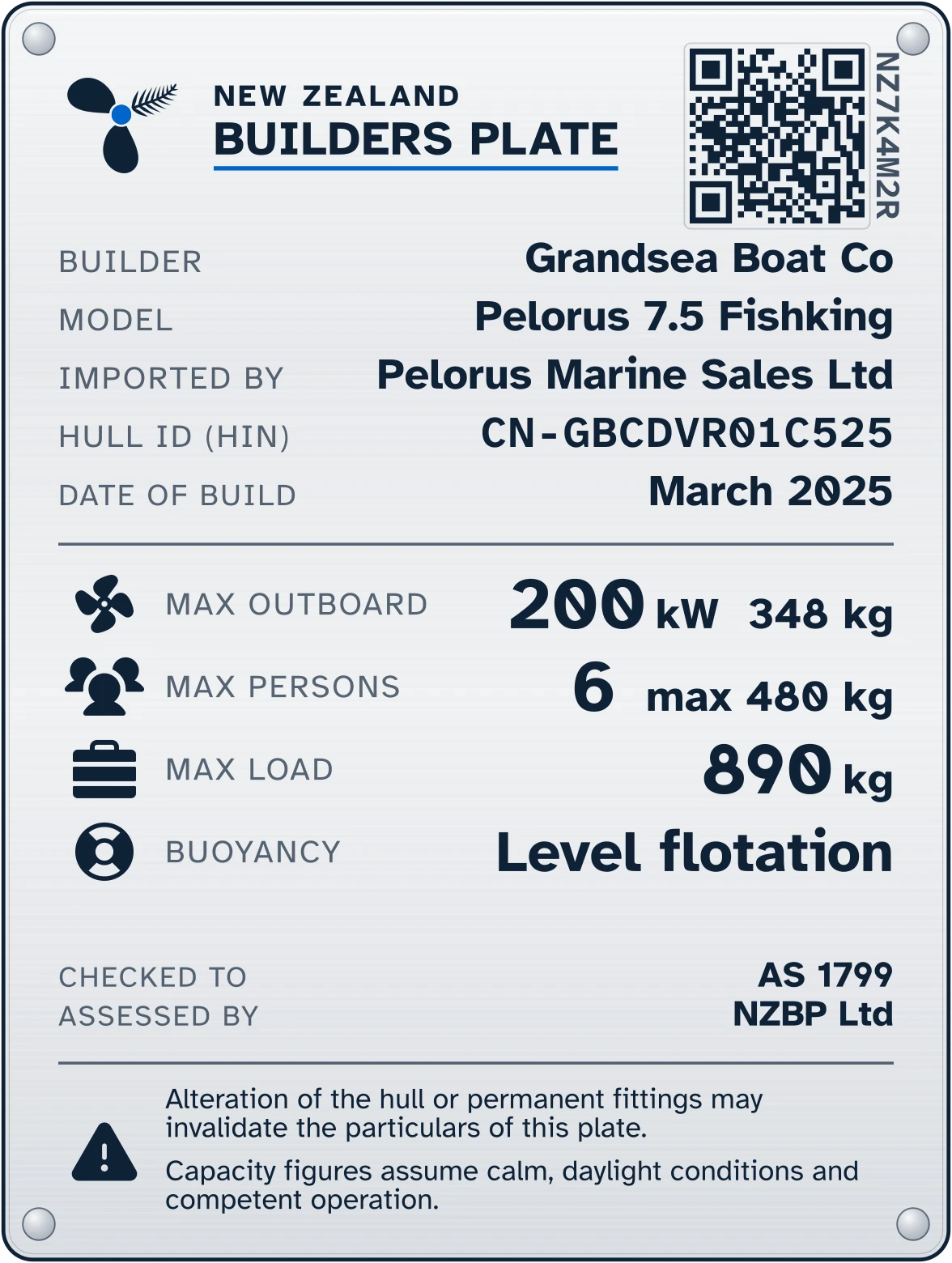
On the plateMax outboard
Stability and buoyancy
How stable the vessel is, and how it behaves if it is swamped or capsized.
On the plateMax persons, Max load, Buoyancy
Operating information
The minimum information an owner must be given to operate the vessel safely.
On the plateThe capacity warning. The owner’s manual is kept on the record.
Fuel and electrical systems
How the fuel and electrical systems are installed so they remain safe in service.
On the recordChecked when required to ensure a safe boat
02THE BASICS
Three terms worth knowing.
What is a standard?
A document published by a recognised body that sets out what a vessel must satisfy to be fit for its intended purpose. Standards are written by naval architects, builders, surveyors and regulators, and they reflect accumulated evidence of how vessels fail.
What is conformance?
A qualified assessor examines the vessel in detail to establish that its design, construction and equipment meet a defined minimum level of safety, and that the boat as built matches its design.
What is a Builders Plate?
A permanent plate fixed to the boat, declaring that it conforms to the standard named on it. It carries the boat’s identity and operating limits, and its QR code opens the record and evidence behind it.
03STABLE, SEAWORTHY, AFLOAT
Stable is not the same as seaworthy.
Three different situations. Flat water, a sea, and a boat that has already filled. Your plate tells you about two of them.
Stability
How your boat behaves on flat water when the weight shifts. Everyone moves to one side to see a fish, and the boat heels. A stiff boat heels a little and stops, and a tender one keeps going. A small open boat usually takes water over the side or the transom before it rolls over. The persons and load limits on your plate come from this. Load past them and the room for error is gone.
Seaworthiness
How your boat copes with a sea. How it rolls and pitches, how much freeboard it keeps, whether the cockpit drains and the hatches hold. The classic small-boat capsize is a following sea that turns the boat beam-on. No standard can predict seaworthiness. The standards set the wind and waves your boat is designed for and check it against them, and the rest is up to you at the helm. Your plate carries no seaworthiness rating. A boat built to a standard has room for error, but its capacity figures assume calm water, daylight and competent handling. Careful operation is what keeps you inside it.
Flotation
What happens once the water is in. Basic flotation keeps your boat afloat, usually stern down under the weight of the engine, with you in the water holding on. Level flotation keeps it upright with the gunwale clear and you in the boat. Neither will right a capsized boat. A boat over 6 m can meet the ISO standard with no flotation at all. So your plate says which kind your boat has, rather than leaving you to assume.

- Transom at the surface.
- Engine under water.
- You are in the water, holding on.

- Gunwale clear all round.
- Cockpit flooded, boat still level.
- You stay in the boat.
04CLOSING THE GAP
Imported boats have had no way to show they conform.
The gap
New Zealand has no construction standards for recreational boats. How a recreational hull is designed and built is left to the builder. Many imported boats already carry recognised overseas compliance marks, such as CE marking, NMMA certification or an Australian Builders Plate, but no New Zealand scheme has previously recognised them.
The existing schemes cover boats built in New Zealand by participating manufacturers. An imported boat has had no way to obtain a conformance certificate.
How NZBP closes it
That is the gap NZBP fills. The scheme is guided by the Australian Builders Plate (ABP) standard. Our assessors draw on AS 1799, the ISO small craft standards and ABYC standards, and apply whichever best suits the boat and upholds safety. That judgement is backed by their NMMA, IMCI, AMSA and Maritime New Zealand certifications. A boat that already holds one of those overseas marks, or a Compliance Plate Certification (CPC), can take a shorter route. We review its certificate in place of a full assessment.
What a plate does
- Declares the standards the boat was checked to
- Shows the safety limits where anyone on board can read them
- States the boat’s buoyancy so buyers and owners can decide on the facts
05WHY NEW ZEALAND BUILDERS PLATE
An independent body, with the people to back it.
Independent
NZBP is not a manufacturer, not a publisher of standards and not a regulator. That lets us assess a vessel according to its design intent and safety system, without a commercial interest in pushing a particular standard.
Qualified
Our surveyors are recognised by Maritime New Zealand and the Australian Maritime Safety Authority, hold IMCI recognition for CE inspection and bring NMMA standards expertise. Our design assessors are chartered naval architects.
Practical
We approach non-conformances in a practical way. Where a design achieves an equivalent safety outcome by another route, we say so and record the reasoning, rather than holding the boat to the absolute wording of a standard.